VACANCY BECOMES A FINANCEABLE PROJECT.
Office to residential, department store to neighbourhood, commercial to mixed use. What stops conversion projects is rarely the idea. It is the financing.
The bank is not the obstacle. It lacks the basis to say yes.
Banks receive documents too late or in a form a credit committee cannot work with. Projects stay in the early phase for years, buildings stay empty. That is expensive and avoidable.
Because the situation has shifted. Since January 2026, large banks must systematically factor ESG risk into lending, with smaller institutions following by early 2027. At the same time the share of taxonomy aligned assets on their books is in the low single digits, and real estate lending is the most important lever to change that.
So the bank is looking for projects like yours. What it lacks is verifiable data: on the fabric, on energy, on cost, on revenue.
That the conversion works is something Frankfurt proves itself. A pure office district from the seventies has become a mixed quarter, with more than 2,600 apartments created there. The market is no longer a promise, it is a matter of record.
That leaves around 12 million euros for acquisition, incidental costs and margin. Which scenario ultimately works, whether sale, rental or a mix, is something CNTXT8 calculates. Based on measured data rather than estimates.
Model calculation based on a genuinely vacant building, costs including incidental construction costs, market values from current comparables.
One set of data, from which every phase draws its result.
We screen the entire portfolio and prioritise by conversion potential.
Our software carries every entry forward from phase to phase and checks it against regulation.
At the end stands the Bankability Pass, generated from the same data.
The cockpit. From filing cabinets to a decision.
Inside the cockpit, specialist agents work on the same building model. They check regulation, screen funding programmes, calculate key figures and flag contradictions. Every statement stays tied to its source, every step stays traceable in the audit trail.
What otherwise takes months and ties up several consultants takes hours to weeks here.
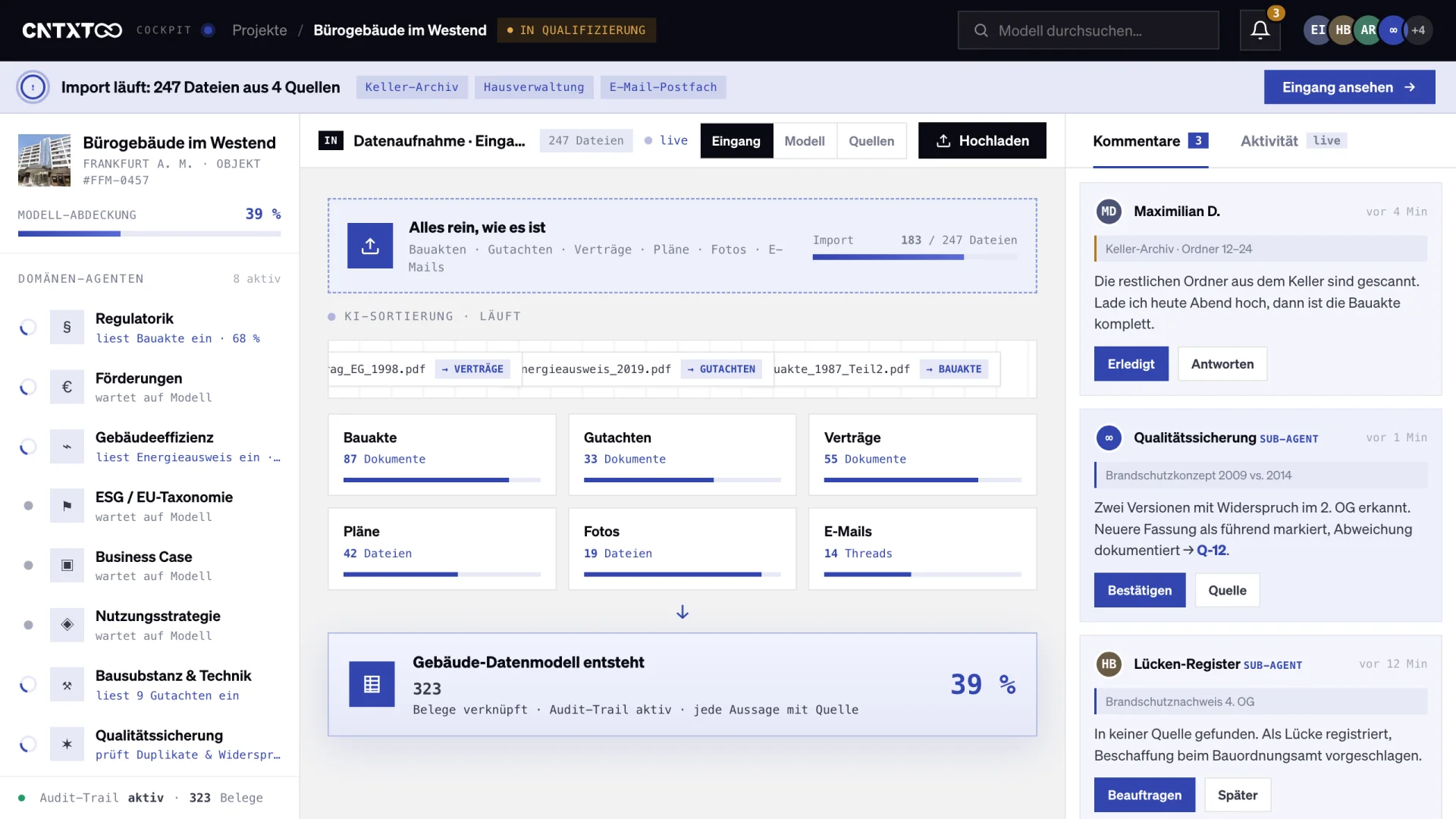
Building records, surveys, contracts, drawings, photos and mail threads go in unsorted. The agents sort them, link them and build a building model from them. What is missing goes into the gap register rather than into an assumption.
The images show a product preview of the CNTXT8 cockpit using sample data.
CNTXT8 does not replace BIM. It adds the strategic and financial view on top. Where BIM maps the design, CNTXT8 maps the decision.
Two perspectives. One goal.
You own a building that is no longer used the way it was originally planned. Space stands empty, running costs rise, the market has moved on.
- Space stands empty or is sublet below value
- Refurbishment obligations from new regulation
- Running costs rise while rental income falls
- The use concept no longer fits the location
- Financing is maturing and refinancing is open
Does this sound like your building?
Then let us find out in one conversation whether a conversion carries. No obligation, and an honest answer even when it is no.
Every phase delivers a result that stands on its own.
We develop a vision for the building. What could future use look like and what does the market need at this location? We examine target groups, forms of housing and achievable rent levels, derive initial scenarios and set the cost framework to DIN 276.
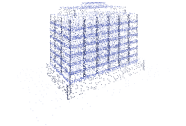
The building is surveyed technically and assessed for energy performance. Measured data rather than assumptions form the basis on which you can decide internally.
- Technical survey using the NavVis system, producing a 3D model and a point cloud of the building
- Energy audit to DIN EN 16247
- Energy consulting for non residential buildings to DIN V 18599
- Technical and energy report on the building
- Action plan with cost estimate to DIN 276
- Business case across several use scenarios
Energy audit and energy consulting are eligible for funding under the German BAFA EBN programme, provided the conditions are met.
Now the documentation is raised to bank quality: prepared along the review standards a bank applies, with full cost calculation to DIN 276, the evidence on ESG and the EU taxonomy, and the funding application.
A pass nobody maintains is just a document a year later. PULSE keeps it current. While construction runs, progress is measured against the cost plan, the schedule and the covenants in the loan agreement. Once the building is in operation, metered consumption keeps the evidence up to date. Your bank sees the same status you do, without having to ask.
- Monitoring during construction against cost plan and schedule
- Drawdowns and bank covenants evidenced rather than asserted
- Deviations reported as soon as they touch cost, schedule or funding
- Consumption data from operation feeds back into the evidence
- ESG and EU taxonomy reporting for every reporting year
- An updated pass for refinancing and for sale
Banks frequently make monitoring during construction a covenant in the loan agreement. PULSE satisfies it from the same data basis the pass was built on.

The Bankability Pass
Every piece of evidence a credit committee reviews, in one document. Fully auditable. And with PULSE it stays that way, through construction and into operation.
Access to capital
The documents match the bank's review standards. And CNTXT8 approaches precisely those banks, funding bodies and investors that finance conversion of existing buildings.
Every result can be verified from outside: recognised standards, DIN 276, the building authority and, in the end, your bank. We do not supply an opinion, we supply documents that others review.
Let us develop a strategy for your building together.
One conversation is enough to see whether CNTXT8 fits your project.